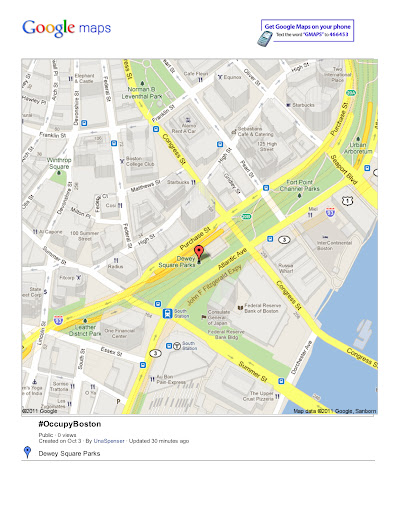
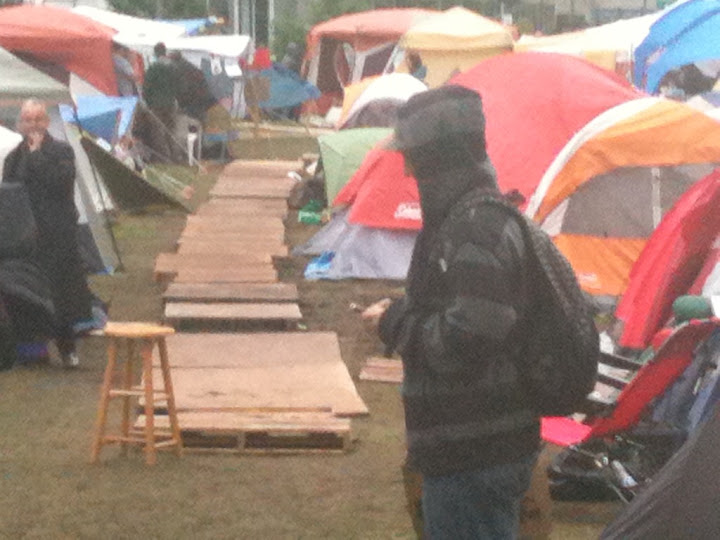
5:13 PM: I love local humor (I don't have to say where right?):

Cancel the Debt.
"Journalists" being paid to infiltrate protests.

As Americans following the increasing number of “occupy” protests wake up this morning, the big news is not happening in the United States right now but in London. An action that you can follow on Twitter with the hashtag #blockthebridge is unfolding as hundreds if not thousands of activists “occupy” the Westminster Bridge to protest a National Health Service reform bill. The protesters have chanted, “We Are the 99%,” in solidarity with occupiers participating in Occupy Wall Street and other “occupy” actions.
UK Uncut is explicitly involved in the action on the Westminster Bridge. Follow @PennyRed for the latest on what is happening on the bridge.
Sign Language from socially_awkwrd on Vimeo.
While the GA was tough, it was the hostility of the crowd that got me panicked.
I also think we should take some time at the beginning of General Assembly to go over the above issue and the crowding issue. After you left at one point I yelled "Get back you are freaking me out!" They immediately did so. But, I think it needs to be addressed.
I personally believe that the issue of sexism is very prevalent in our camp. I have personally spoken with about 10 women who feel really uncomfortable and intimidated during GAs and in general in their interaction with some men. Majority grievances were about men who are active in the camp not new visitors.
I am in complete alignment with these thoughts and feelings. I will NOT facilitate again until issues of gender and the difference of empowering someone to do a job in service of the community versus this idea that someone performing a job is abusing power are worked out.Those are snippets from four different women in the Facilitation working group. The last comment is from me. I had missed when the crowd had gotten so hostile that a facilitator quit in the middle of the evening. I missed it because there was a contingent in the crowd who actively undermined moving ahead with an agenda item that the entire community had reached consensus upon the night before. When that happened and there was no structure in place, a young man took the microphone and started to read the NY General Assembly's declaration. I think he was pushing for a vote to proclaim official solidarity with that statement. I don't know because, he was reading as some kind of performance art which meant he was gradually raising his voice until he was screaming in anger into the microphone. I felt assaulted and I left. I later learned that the decision to ratify it was tabled.


Thursday, in peaceful solidarity with Occupy Wall Street, the occupation of Portland, Oregon, began. According to reports, approximately 10,000 peaceful Oregonians marched....
The occupation of Portland is modeled after the occupation currently taking place in the financial district of New York City....
Thursday morning, Mayor Sam Adams issued a positive statement concerning Occupy Portland. The following is an excerpt from that statement:
The City of Portland has been preparing for the Occupy Portland event, with a goal of facilitating a peaceful, effective, and orderly event where everyone is safe.
I support Portlanders in their right to protest and exercise free speech rights, and I encourage all who participate to do so peacefully and with respect to the rights of others. Most of the people that are going to participate in Occupy Portland--as with most of the participants in cities across the country--are there to voice their legitimate concerns about national issues. A peaceful event is the most effective way for participants to deliver that message.
Mayor Adams' open and welcoming attitude is a far cry from New York Mayor Michael Bloomberg’s condemnation of the occupation currently taking place in his city. Indeed, Adams briefly joined the Occupy Portland march in order to thank citizens for their peaceful and well behaved protest.
There’s something happening here. What it is ain’t exactly clear, but we may, at long last, be seeing the rise of a popular movement that, unlike the Tea Party, is angry at the right people.
When the Occupy Wall Street protests began three weeks ago, most news organizations were derisive if they deigned to mention the events at all. For example, nine days into the protests, National Public Radio had provided no coverage whatsoever.
It is, therefore, a testament to the passion of those involved that the protests not only continued but grew, eventually becoming too big to ignore. With unions and a growing number of Democrats now expressing at least qualified support for the protesters, Occupy Wall Street is starting to look like an important event that might even eventually be seen as a turning point.
What can we say about the protests? First things first: The protesters’ indictment of Wall Street as a destructive force, economically and politically, is completely right.
A weary cynicism, a belief that justice will never get served, has taken over much of our political debate — and, yes, I myself have sometimes succumbed. In the process, it has been easy to forget just how outrageous the story of our economic woes really is. So, in case you’ve forgotten, it was a play in three acts.
In the first act, bankers took advantage of deregulation to run wild (and pay themselves princely sums), inflating huge bubbles through reckless lending. In the second act, the bubbles burst — but bankers were bailed out by taxpayers, with remarkably few strings attached, even as ordinary workers continued to suffer the consequences of the bankers’ sins. And, in the third act, bankers showed their gratitude by turning on the people who had saved them, throwing their support — and the wealth they still possessed thanks to the bailouts — behind po
liticians who promised to keep their taxes low and dismantle the mild regulations erected in the aftermath of the crisis.
Given this history, how can you not applaud the protesters for finally taking a stand?
Now, it’s true that some of the protesters are oddly dressed or have silly-sounding slogans, which is inevitable given the open character of the events. But so what?...
A better critique of the protests is the absence of specific policy demands. It would probably be helpful if protesters could agree on at least a few main policy changes they would like to see enacted. But we shouldn’t make too much of the lack of specifics. It’s clear what kinds of things the Occupy Wall Street demonstrators want, and it’s really the job of policy intellectuals and politicians to fill in the details.
Rich Yeselson, a veteran organizer and historian of social movements, has suggested that debt relief for working Americans become a central plank of the protests. I’ll second that, because such relief, in addition to serving economic justice, could do a lot to help the economy recover. I’d suggest that protesters also demand infrastructure investment — not more tax cuts — to help create jobs. Neither proposal is going to become law in the current political climate, but the whole point of the protests is to change that political climate.
And there are real political opportunities here. Not, of course, for today’s Republicans, who instinctively side with those Theodore Roosevelt-dubbed “malefactors of great wealth.” Mitt Romney, for example — who, by the way, probably pays less of his income in taxes than many middle-class Americans — was quick to condemn the protests as “class warfare.”
But Democrats are being given what amounts to a second chance. The Obama administration squandered a lot of potential good will early on by adopting banker-friendly policies that failed to deliver economic recovery even as bankers repaid the favor by turning on the president. Now, however, Mr. Obama’s party has a chance for a do-over. All it has to do is take these protests as seriously as they deserve to be taken.
And if the protests goad some politicians into doing what they should have been doing all along, Occupy Wall Street will have been a smashing success.
I was honored to be invited to speak at Occupy Wall Street on Thursday night. Since amplification is (disgracefully) banned...what I actually say at Liberty Plaza will have to be very short. With that in mind, here is the longer, uncut version of the speech.
I love you.
And I didn’t just say that so that hundreds of you would shout “I love you” back...
Yesterday, one of the speakers at the labor rally said: “We found each other.” That sentiment captures the beauty of what is being created here. A wide-open space (as well as an idea so big it can’t be contained by any space) for all the people who want a better world to find each other. We are so grateful.
If there is one thing I know, it is that the 1 percent loves a crisis. When people are panicked and desperate and no one seems to know what to do, that is the ideal time to push through their wish list of pro-corporate policies: privatizing education and social security, slashing public services, getting rid of the last constraints on corporate power. Amidst the economic crisis, this is happening the world over.
And there is only one thing that can block this tactic, and fortunately, it’s a very big thing: the 99 percent. And that 99 percent is taking to the streets from Madison to Madrid to say “No. We will not pay for your crisis.”
That slogan began in Italy in 2008. It ricocheted to Greece and France and Ireland and finally it has made its way to the square mile where the crisis began.
“Why are they protesting?” ask the baffled pundits on TV. Meanwhile, the rest of the world asks: “What took you so long?” “We’ve been wondering when you were going to show up.” And most of all: “Welcome.”
Many people have drawn parallels between Occupy Wall Street and the so-called anti-globalization protests that came to world attention in Seattle in 1999. That was the last time a global, youth-led, decentralized movement took direct aim at corporate power. And I am proud to have been part of what we called “the movement of movements.”
But there are important differences too. For instance, we chose summits as our targets: the World Trade Organization, the International Monetary Fund, the G8. Summits are transient by their nature, they only last a week. That made us transient too....
Occupy Wall Street, on the other hand, has chosen a fixed target. And you have put no end date on your presence here. This is wise. Only when you stay put can you grow roots. This is crucial. It is a fact of the information age that too many movements spring up like beautiful flowers but quickly die off. It’s because they don’t have roots. And they don’t have long term plans for how they are going to sustain themselves. So when storms come, they get washed away.
Being horizontal and deeply democratic is wonderful. But these principles are compatible with the hard work of building structures and institutions that are sturdy enough to weather the storms ahead. I have great faith that this will happen.
Something else this movement is doing right: You have committed yourselves to non-violence. You have refused to give the media the images of broken windows and street fights it craves so desperately....
But the biggest difference a decade makes is that in 1999, we were taking on capitalism at the peak of a frenzied economic boom. Unemployment was low, stock portfolios were bulging. The media was drunk on easy money. Back then it was all about start-ups, not shutdowns.
We pointed out that the deregulation behind the frenzy came at a price. It was damaging to labor standards. It was damaging to environmental standards. Corporations were becoming more powerful than governments and that was damaging to our democracies. But to be honest with you, while the good times rolled, taking on an economic system based on greed was a tough sell, at least in rich countries.
Ten years later, it seems as if there aren’t any more rich countries. Just a whole lot of rich people. People who got rich looting the public wealth and exhausting natural resources around the world.
The point is, today everyone can see that the system is deeply unjust and careening out of control. Unfettered greed has trashed the global economy. And it is trashing the natural world as well....
These are the facts on the ground. They are so blatant, so obvious, that it is a lot easier to connect with the public than it was in 1999, and to build the movement quickly.
We all know, or at least sense, that the world is upside down: we act as if there is no end
to what is actually finite—fossil fuels and the atmospheric space to absorb their emissions. And we act as if there are strict and immovable limits to what is actually bountiful—the financial resources to build the kind of society we need.
The task of our time is to turn this around: to challenge this false scarcity. To insist that we can afford to build a decent, inclusive society—while at the same time, respect the real limits to what the earth can take.
What climate change means is that we have to do this on a deadline. This time our movement cannot get distracted, divided, burned out or swept away by events. This time we have to succeed. And I’m not talking about regulating the banks and increasing taxes on the rich, though that’s important.
I am talking about changing the underlying values that govern our society. That is hard to fit into a single media-friendly demand, and it’s also hard to figure out how to do it. But it is no less urgent for being difficult.
That is what I see happening in this square. In the way you are feeding each other, keeping each other warm, sharing information freely and proving health care, meditation classes and empowerment training. My favorite sign here says, “I care about you.” In a culture that trains people to avoid each other’s gaze, to say, “Let them die,” that is a deeply radical statement.
A few final thoughts. In this great struggle, here are some things that don’t matter.
§ What we wear.
§ Whether we shake our fists or make peace signs.
§ Whether we can fit our dreams for a better world into a media soundbite.
And here are a few things that do matter.
§ Our courage.
§ Our moral compass.
§ How we treat each other.
We have picked a fight with the most powerful economic and political forces on the planet. That’s frightening. And as this movement grows from strength to strength, it will get more frightening. Always be aware that there will be a temptation to shift to smaller targets—like, say, the person sitting next to you at this meeting. After all, that is a battle that’s easier to win.
Don’t give in to the temptation. I’m not saying don’t call each other on shit. But this time, let’s treat each other as if we plan to work side by side in struggle for many, many years to come. Because the task before will demand nothing less.
Let’s treat this beautiful movement as if it is most important thing in the world. Because it is. It really is.
Editor’s Note: Naomi’s speech also appeared in Saturday’s edition of the Occupied Wall Street Journal.
Naomi Klein, the Canadian journalist famous for her anti-corporatist books No Logo and The Shock Doctrine, spoke to the protesters at Occupy Wall Street yesterday evening, telling them their movement can follow through on the promises of the global trade protests she participated in a decade ago.
Speaking through cycles of call-and-response because the protesters have been denied a sound permit, Klein urged the protesters not to lapse into structureless disorganization.
"Being horizontal and deeply democratic is wonderful," she told them. "But these principles are compatible with the hard work of building structures and institutions that are sturdy enough to weather the storms ahead. I have great faith that this will happen."
The complete text of Klein's speech can be found here.
Klein's prepared remarks clearly rallied the occupiers, but some of her most interesting comments came as answers to questions posed to her afterwards. Asked how the movement can withstand the supposed sympathies of establishment politicians with questionable motives, Klein said "Don't worry about it. What will make this movement vulnerable is if it doesn't develop its own democratic mechanisms to speak for itself. Then it's vulnerable to people using your energy to fight for limited small changes. It's in your power to not let this happen. You are not cannon fodder for Washington policy wonks."
And when another protester asked: "Some Democrat leaders say this is the answer to the Tea Party. Why do you disagree with that?", Klein's answer was terse: "I think this is the answer to the Democratic party.
"We can have allies who are elected representatives," she said. "But I don't think that's what this movement is about.
What's the most powerful thing we can do as individuals to spread the movement?, Klein was asked.
"Tell your friends how fun it is," she said. "That's the most dangerous thing about it."
Another protester asked Klein a version of a question on many occupier's lips: "How do we transform the energy of the movement into something that is actually happening?"
"Something is happening," she said. "You're giving the people courage. You're telling them they're not alone and they're not crazy. You're giving them a space to find one another. But this is not group therapy -- we also want to change the world. This movement has to create democratic structures. It just can't happen overnight, but I beg you not to fetishize not having a structure. We made that mistake, and it destroyed our movement."
Couple of 'protesters' with badges move out of the back of the crowd and join the police.

Troy Davis, Medgar Evers, Emmett Till, Martin Luther King.

What should the Occupy Wall Street organizers do? They should continue on the path they were on prior to all the labor and Democratic Party support. They should put the movement first and not bow to any Democratic Party or liberal organization operatives who seek to channel the movement into electoral politics or compel the movement to lower its sights. It should work to maintain a level of discipline and make sure it establishes what it is not. It should continue to aim for the impossible and remember that they have earned their power because they have occupied the park and stood their ground in the face of a media blackout, police brutality and contemptuous criticisms.
The occupiers did not come together to be the Tea Party of the left. They came together to take on corporate power and address problems that impact Americans who are conservative and liberal, left wing and right wing. And, to continue to grow as a movement that challenges the influence of corporations, special interests and the top 1% in government, they need to make clear this is not about building a better Democratic Party. This is about the war on poor, working class and middle class Americans, the constant attacks on unions and how Americans are begin to have influence over their government so the assaults on poor and working Americans come to an end.


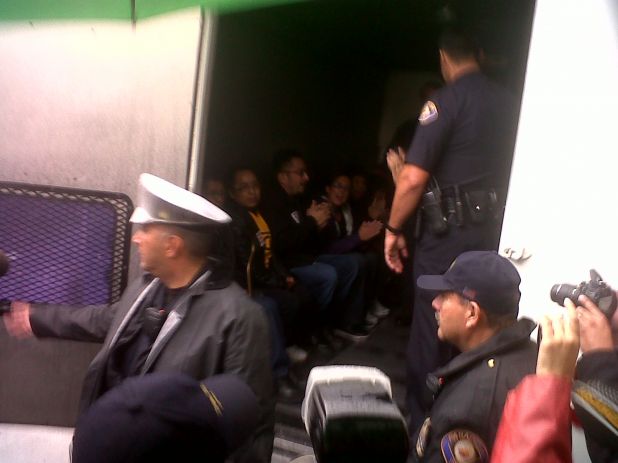


Confirmed reports of walkouts in New York, Massachusetts, Washington, California, North Carolina, Texas. More coming in all the time, many states with multiple walkouts.

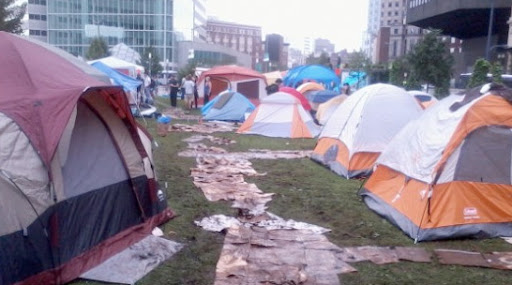 The grass makes for a softer environment than all of the marble and concrete of Liberty Square. However, it also means that rain leads to mud, which leads to a grimy cardboard walkway. (see below for photo of infrastructure upgrade!) Muckier than NY due to the mud, but less cluttered and more contained due the tents.
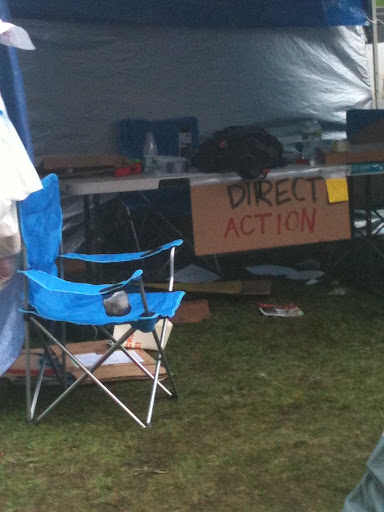 I had to walk around to see that there were people preparing and serving food in the Food Tent and people working at computers in the media tent, etc. There were a few people milling about, but most of the activity was happening inside tents, so the energy was partitioned. Now, I had arrived at #occcupywallstreet a week after the encampment began, so some of this may be the difference between how established the occupations were. Also, there was a march ongoing when I arrived in Dewey Square, meaning that a lot of people were off site. Still, even when marches were underway in New York, there were lots of people scurrying around.
Open Reflection on Collective ThinkingHere, they define what a General Assembly (also knows as a People's Assembly) is:
To our understanding, Collective Thinking is diametrically opposed to the kind of thinking propounded by the present system. This makes it difficult to assimilate and apply. Time is needed, as it involves a long process. When faced with a decision, the normal response of two people with differing opinions tends to be confrontational. They each defend their opinions with the aim of convincing their opponent, until their opinion has won or, at most, a compromise has been reached.
The aim of Collective Thinking, on the other hand, is to construct. That is to say, two people with differing ideas work together to build something new. The onus is therefore not on my idea or yours; rather it is the notion that two ideas together will produce something new, something that neither of us had envisaged beforehand. This focus requires of us that we actively listen, rather than merely be preoccupied with preparing our response.
Collective Thinking is born when we understand that all opinions, be these opinions our own or others’, need to be considered when generating consensus and that an idea, once it has been constructed indirectly, can transform us.
Do not be discouraged: we are learning; we’ll get there: all that’s needed is time.
emphasis mine
What is a People’s Assembly? It is a participatory decision-making body which works towards consensus. The Assembly looks for the best arguments to take a decision that reflects every opinion – not positions at odds with each other as what happens when votes are taken. It must be pacific, respecting all opinions: prejudice and ideology must left at home. An Assembly should not be centered around an ideological discourse; instead it should deal with practical questions: What do we need? How can we get it? The Assembly is based on free association – if you are not in agreement with what has been decided, you are not obliged to carry it out. Every person is free to do what they wish – the Assembly tries to produce collective intelligence, and shared lines of thought and action. It encourages dialogue and getting to know one another.Notice the key defining phrase, "decision-making body", and a key aspect of the decision-making process, time. The overall citizenry of #OccupyBoston don't hold this understanding. There doesn't seem to be a critical mass of the citizenry who do and who can protect the process so that the General Assembly can function as such. At the General Assembly I attended on Saturday night, I saw very few actual decisions made. There were a lot of announcements, a lot of camp logistics discussed and then a discussion on "messaging" which was done via people breaking into groups and then having groups representatives report out their group's thoughts about messaging. (I'll write another time about the "messaging" meme.) This was the only time when people seemed engaged and had energy about what was being said. It ultimately fell flat, though, because it was unclear what the process was leading to. There weren't any proposals on the table or decisions to be made. There were a few "rah rah" moments, but once that cheering dissipated there was nothing of substance left.